
Machine Knitting Overview
Please be aware that the knitting machine will be in use for inductions on Thursdays and Fridays 10:00-13:00
The Silver Reed SK840 knitting machine is a 4.5mm standard-gague knitting machine that is intended for use with 3- and 4-ply yarns. The Silver Reed manual is available online here, and we have a paper copy in the workshop (as the online copy is poorly digitised, we will also make a better copy soon).
You must have been inducted by a member of staff (currently, ask Agnes or Rosie) before using the machine!
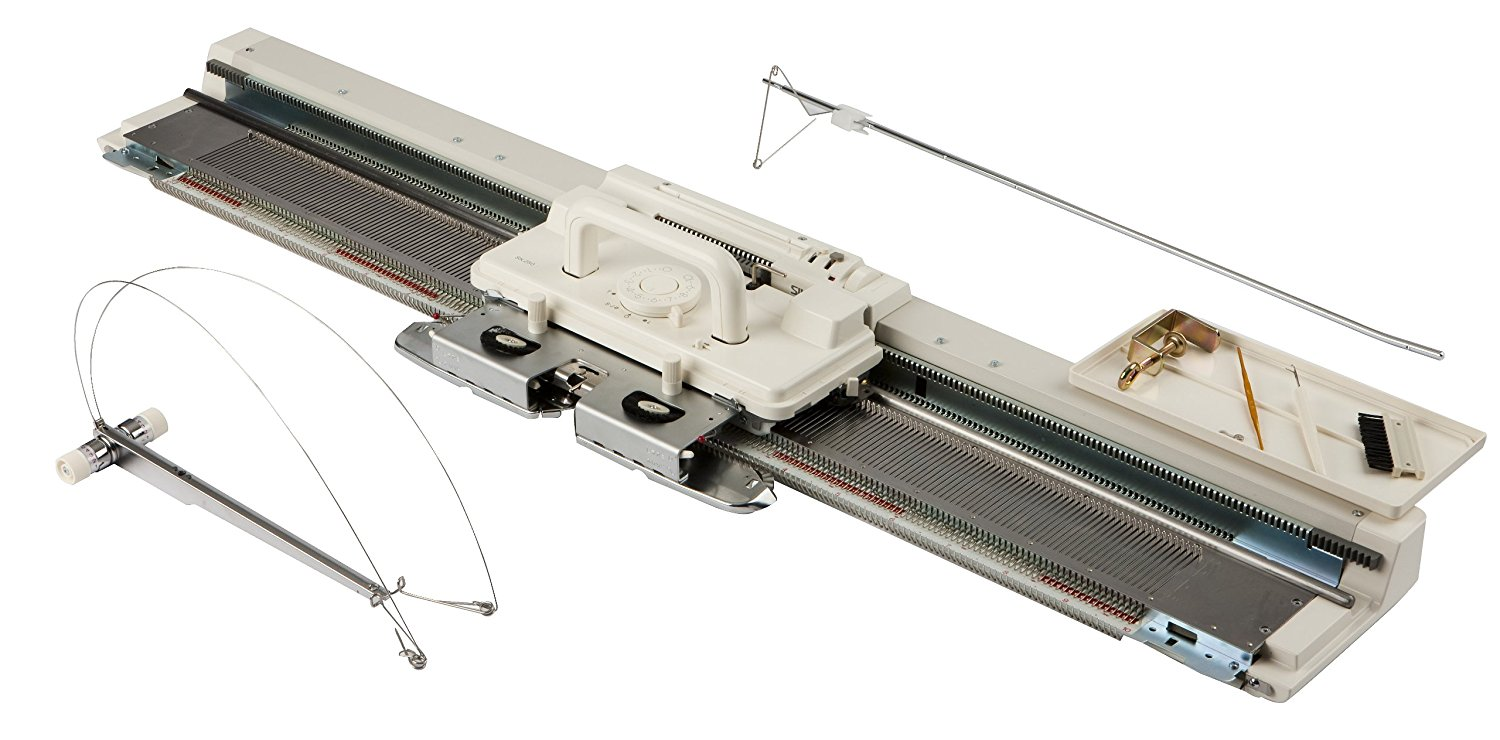
The SK840 is a domestic knitting machine, and requires some manual input to operate. Fully-automated machines are normally referred to as 'industrial' knitting machines, to differentiate them from their domestic equivalents. Despite the lack of full automation, domestic knitting machines are often used in fashion for prototyping and designing new textiles. To learn more about industrial machines, this video gives an overview of common types, and this video is a good intro guide to knitting in general. If you want to look deeper into industrial knitting principles, the Indian Institute of Technology's textile technology department has a whole lecture series online that's very clear and gives a great amount of detail.
Stitches and Techniques
In machine knitting, knitted fabric is created by manually sliding the carriage back and forth over the needle bed. Each stitch is formed as the needle pulls a new loop of yarn through the stitch on the previous row. Knitting is distinct from weaving: in weaving, fabric is created by interlacing 2 sets of threads at right angles to one another, while knitting involves taking a single thread and looping it around itself, one row at a time. (we currently don't have any weaving capabilities in the CCI).
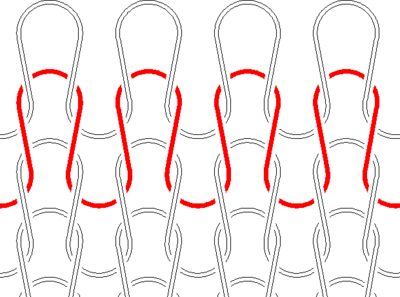
The two foundation stitches in knitting are the knit and purl stitches. These are the reverse of each other, meaning that you are pulling the yarn through the previous stitch from the opposite direction.
Stockinet
This is the simplest form of knitting, and equivalent to a knit stitch in hand knitting. It produces a flat, smooth side (the 'right side') and a rougher side ('wrong side'). To knit stockinet, select the 'O' stitch setting on the carriage.
All stitch varieties listed here still require a stockinet cast-on.
Fair Isle and Patterning
Fair Isle knitting is a common way of creating patterns in knitted textiles, by alternating between 2 colours within each row. On the SK840, this is also one of the three stitches (the others being slip and tuck stitches) that may be automatically controlled using the SilverLink controller; it's quite low-effort to produce some really beautiful, impressive things that it would be very hard to knit by hand.
To knit Fair Isle, the machine should be connected to the computer via the SilverLink, and DesignaKnit should be in interactive knitting mode. The carriage should be turned to 'F' for Fair Isle, and the arm should be threaded with 2 yarns (the first in position 1, the second in position 2).
This video shows the technique using punch-cards rather than the computer, but the core ideas are the same. For more guidance on creating patterns using DesignaKnit, see the wiki page on Creating Digital Knitting Patterns with DesignaKnit.
Bird's Eye
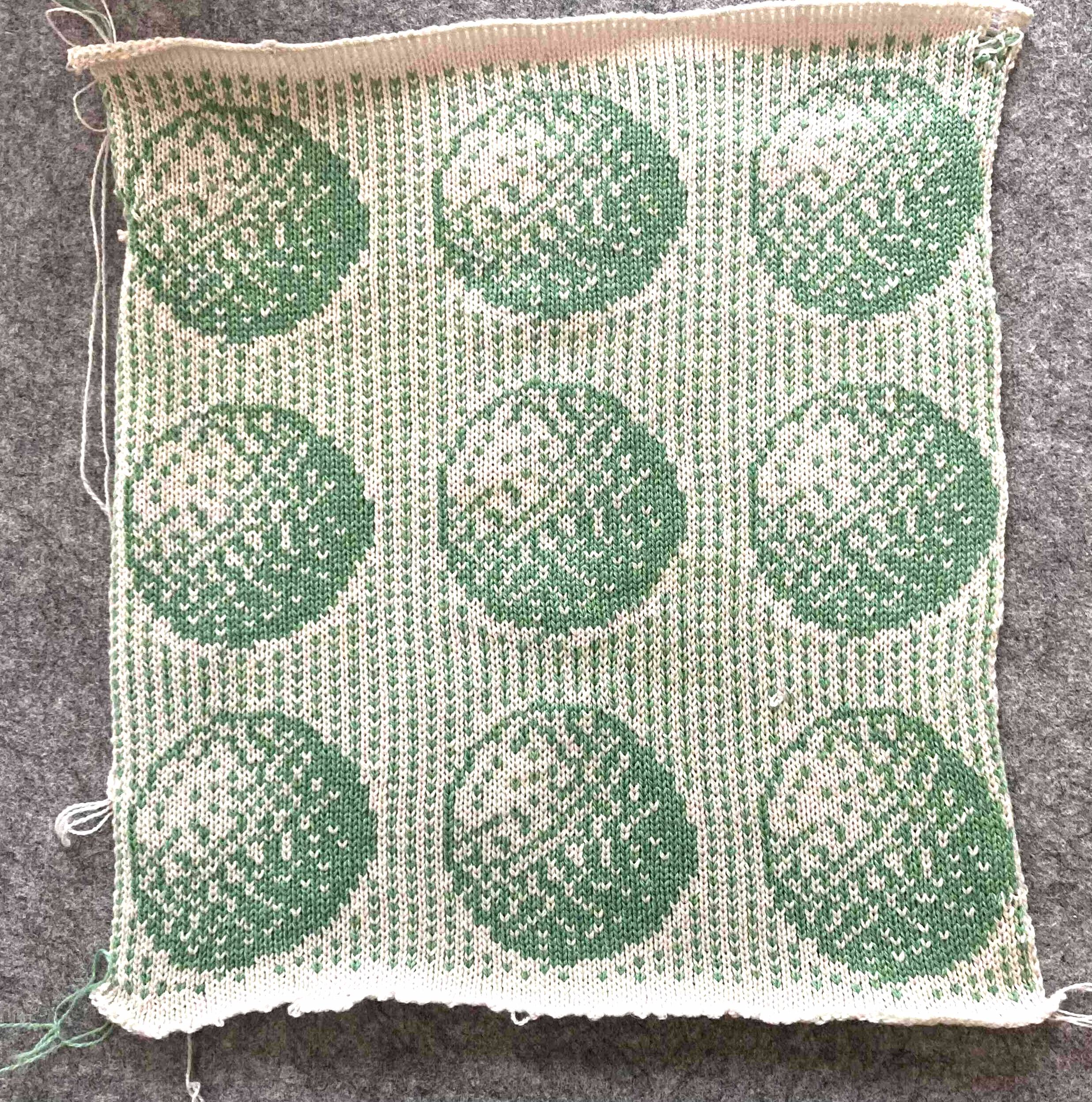
Bird's Eye is a pattern that can be added to fair isle pieces to control the length of floats. This is useful when creating pieces where the reverse side will be open, such as jumpers, to reduce the chance of catching threads.
Dithering
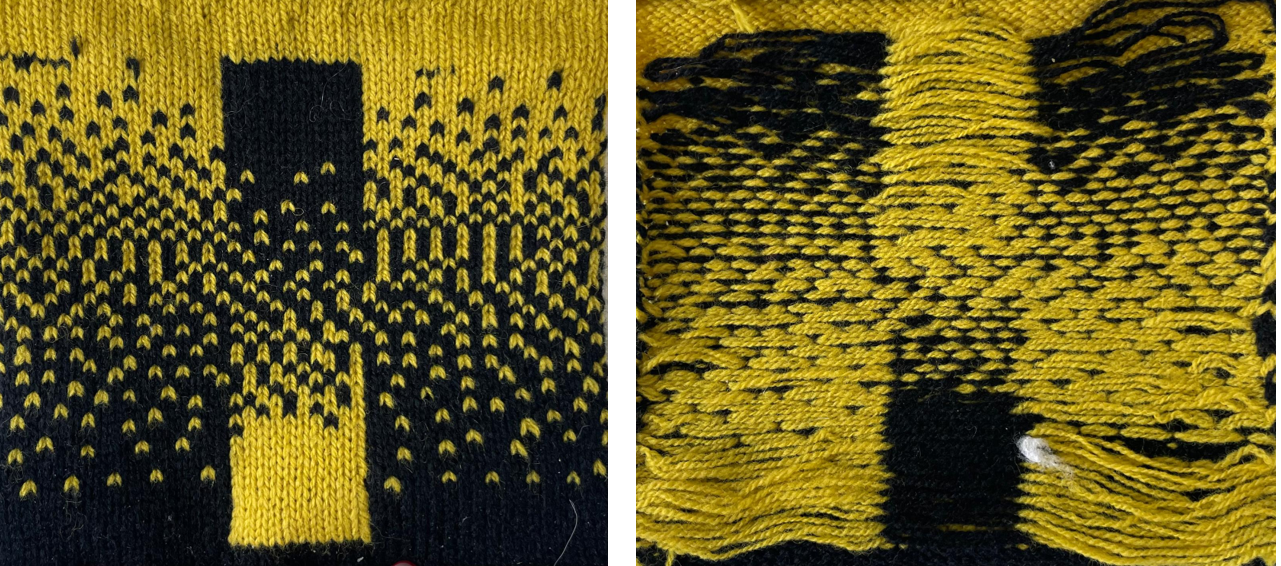
Dithering is an intentionally applied form of noise commonly used to convert a grayscale image to black and white, so that the density of black dots in the new image approximates the average gray level in the original. As we can only use two colours per row, this can be used to convert greyscale images into fair isle knitting patterns.
Short Rowing (or Partial Knitting)
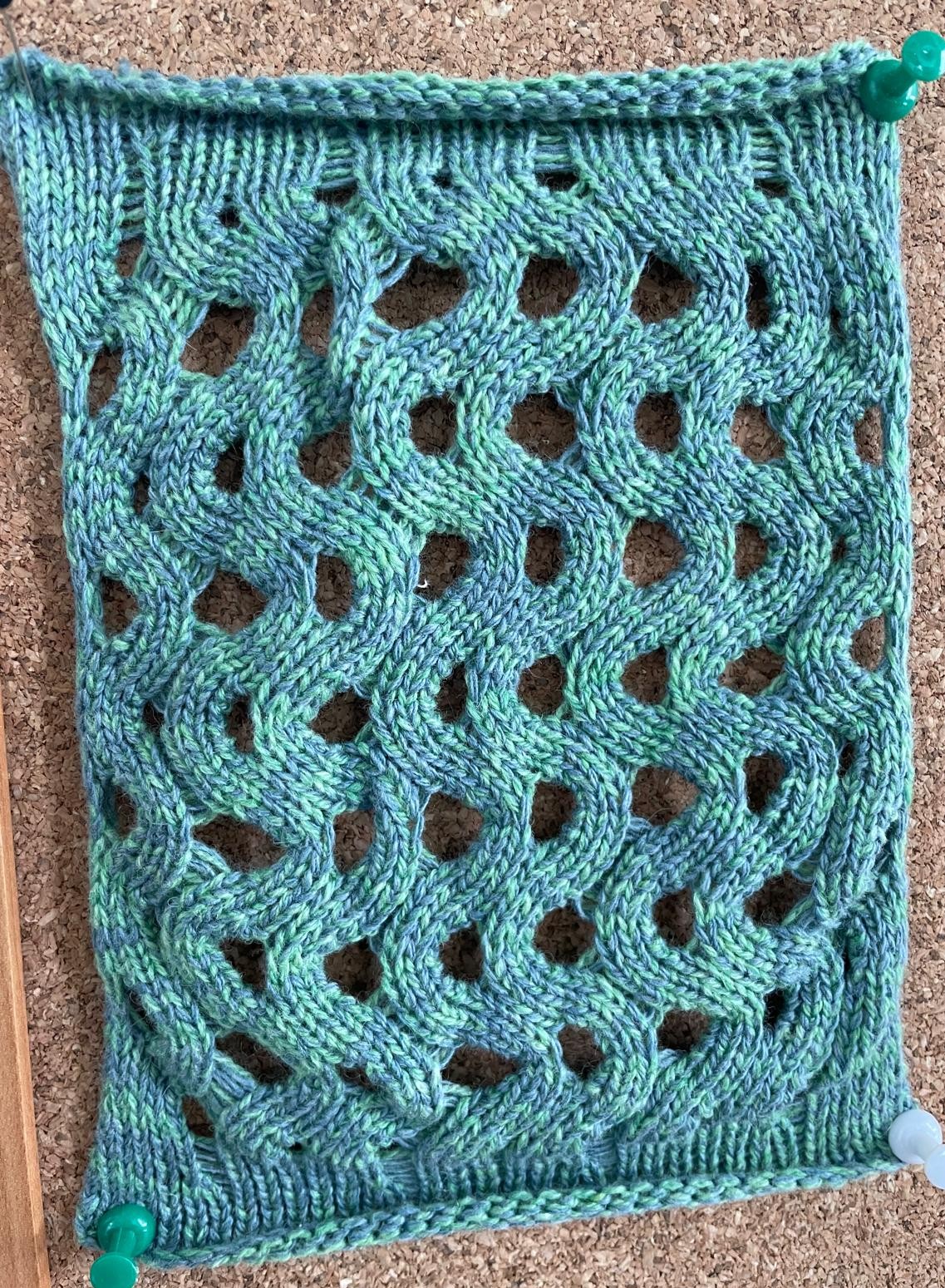
Short rowing is a method that allows you to put needles 'on hold' and knit a row without adding a new stitch onto every needle (called a short or partial row). This allows you to create interesting shapes including non-flat and curved swatches (such as the heel or toe of a sock).
Slip Stitch
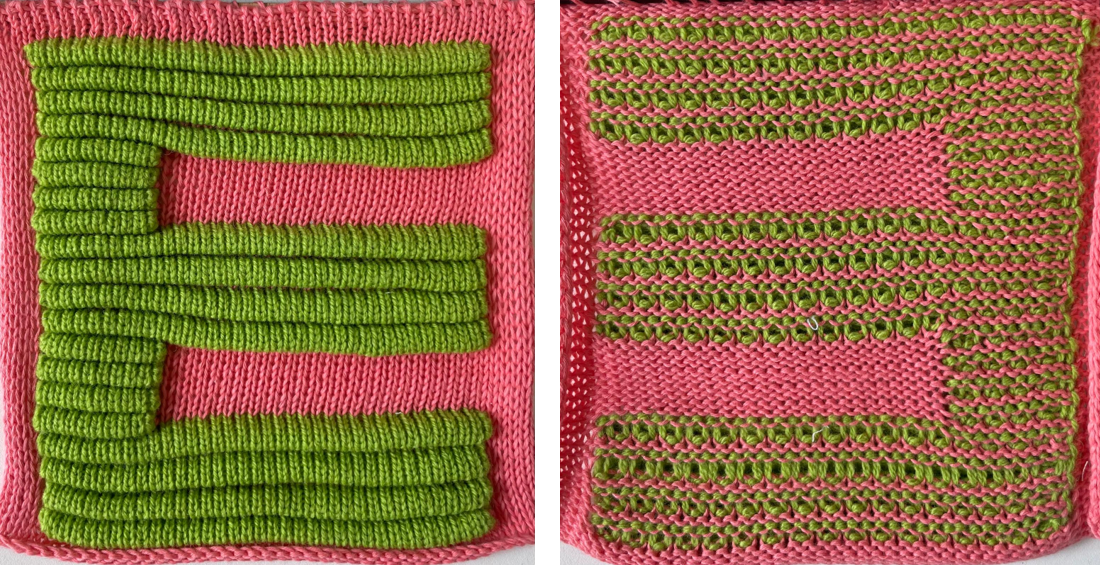
Slip stitch is a knitting technique where a stitch is skipped (or 'slipped'), that can be used to add texture to knitted fabrics either manually or automatically (using the SilverLink). Skipping stitches creates patterns in the strands of un-knitted yarn, and is often used alongside other texturing techniques.
Tuck Stitch
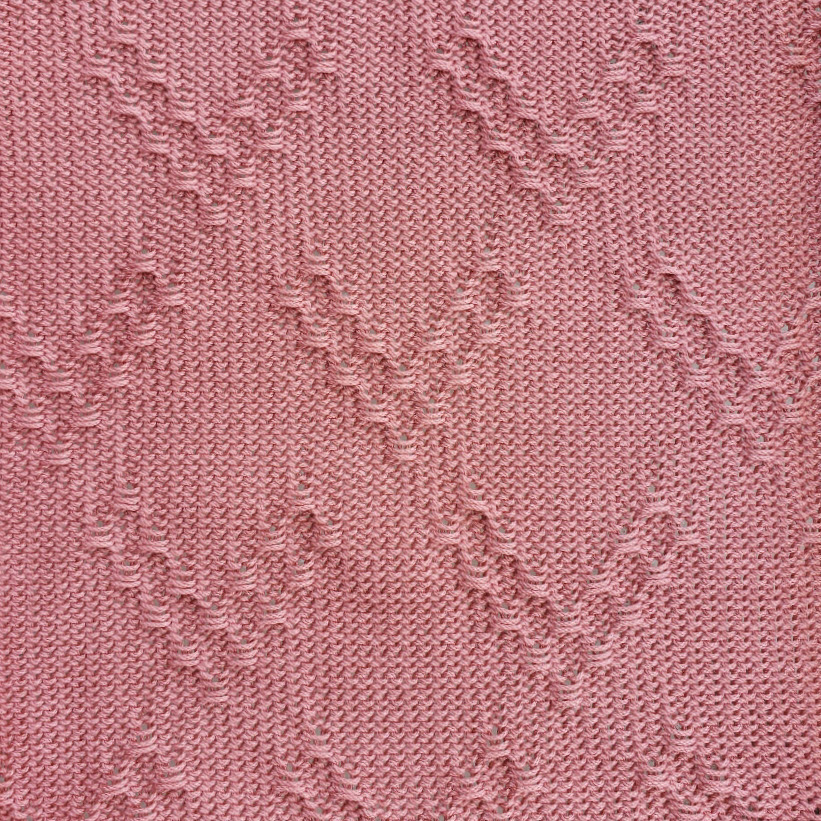
Tuck stitch is a knitting technique that involves tucking a stitch from one row into a row above. Like slip stitch, tuck stitch can manipulate the texture of the knitted fabric, though somewhat more dramatically, as depending on the depth of the tuck the fabric can be structured in all sorts of interesting ways. Stitches may be tucked automatically using the SilverLink.
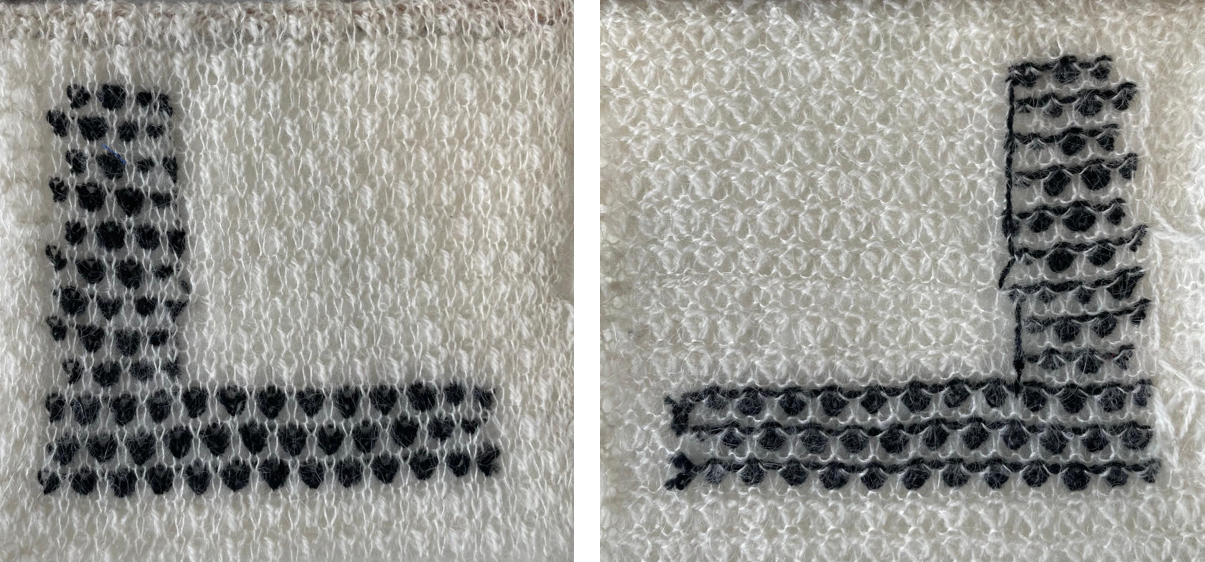
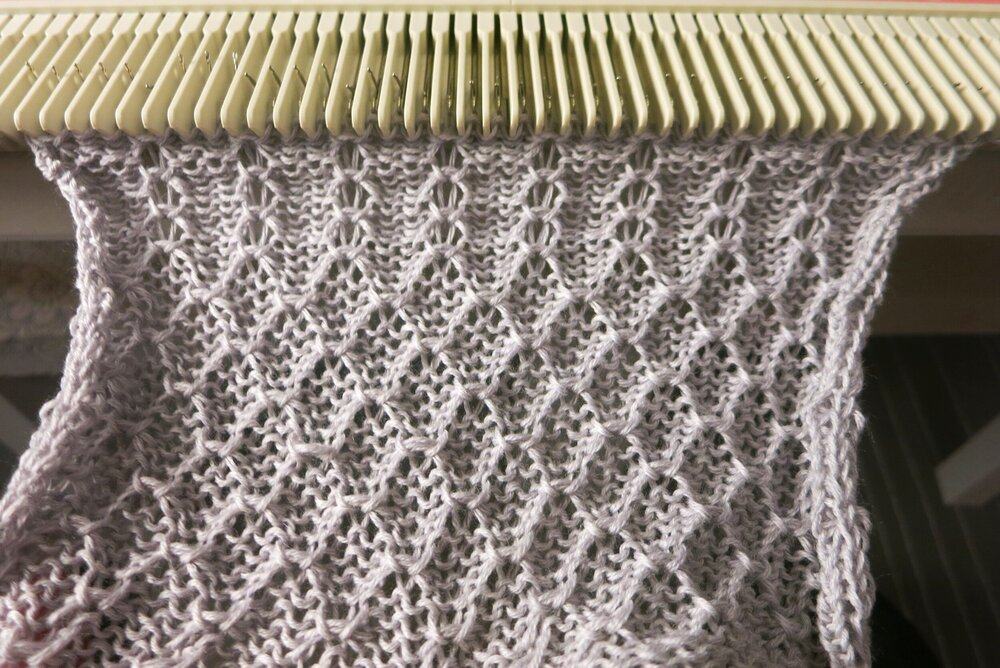
Tuck Mosaic
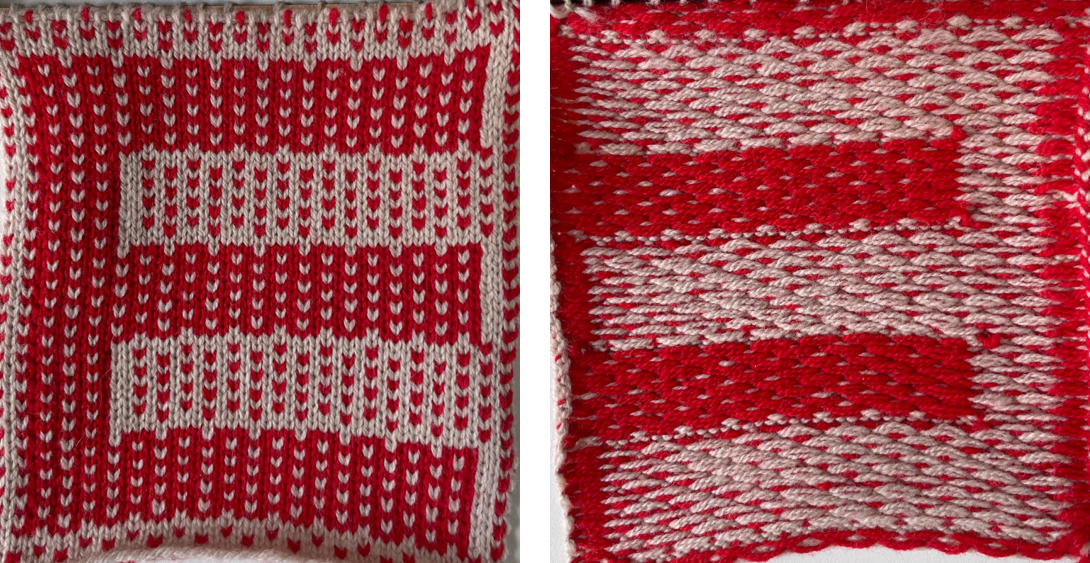
The 2 colours here are knitted in horizontal stripes, but with a regular pattern of stitches 'tucked' into the stitch above, manipulating the structure to resemble vertical lines. The result looks very beautiful, but it's time-consuming to change the colour every 2 rows.
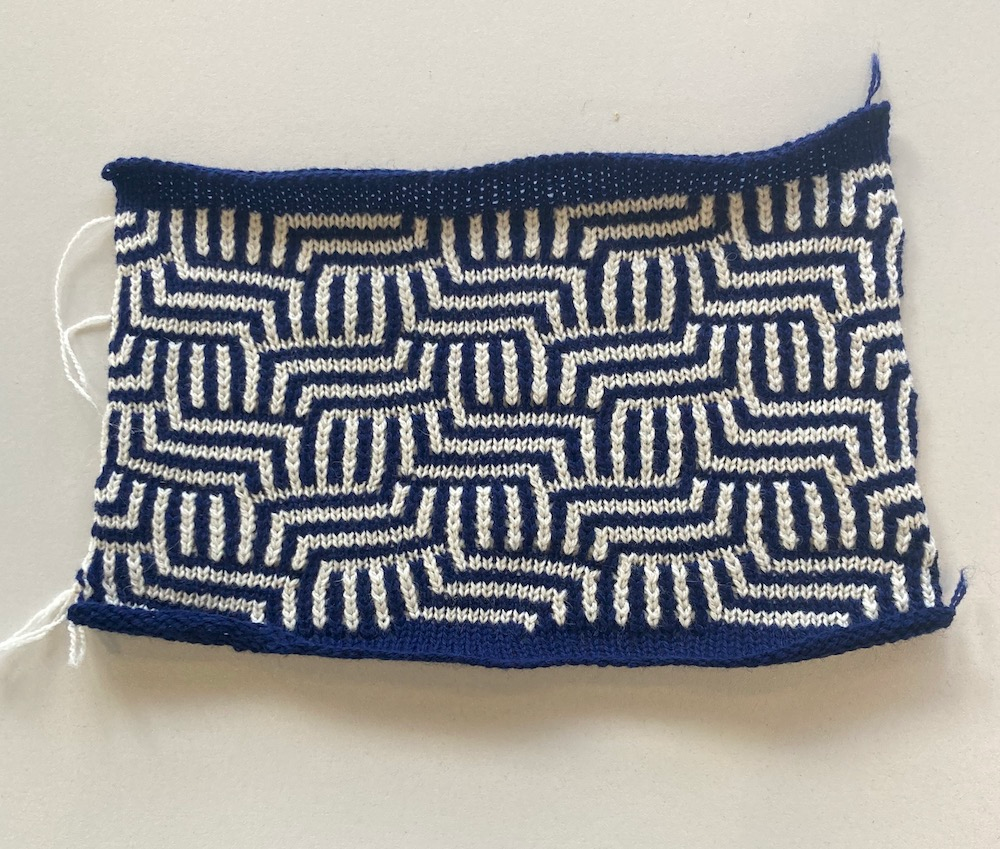
What's interesting about tuck patterns is that they look nothing like the patterns that produce them. There's a great and incredibly detailed blog post on Alessandrina (very helpful knitting blog) which explains in great detail.
Mock Rib
Many knitted garments are hemmed with a stretchier 'rib' edge (think cuffs, collar and bottom of a sweater, for example). This adds structural stability to the fabric and also looks great. Typically this is done using a 'ribber', or a double bed machine, which we don't have in the CCI. However, it's perfectly possible to make a mock rib using a single bed machine that's functionally very similar.
I watched this video for guidance, which was pretty good (it's in Norwegian, but English subtitles), which gives a good guide to creating a 'mock' rib on a single bed machine.
Knitting with every other needle
This is used to knit yarns like mohair, or chunkier yarns. This video (it's in Norwegian, but has English subtitles) gives a good demonstration of the cast-on technique required: after casting on, knit as normal, but with only half the needles engaged.
Special tools and carriages
Intarsia
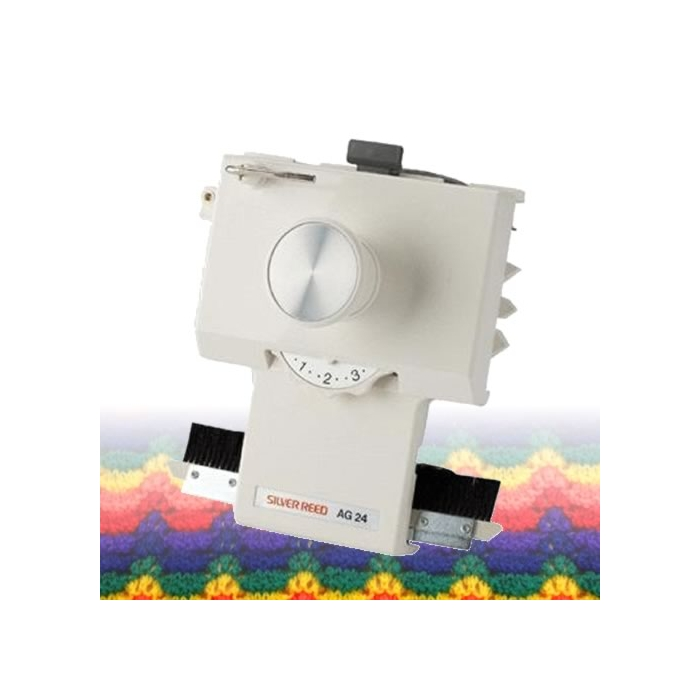
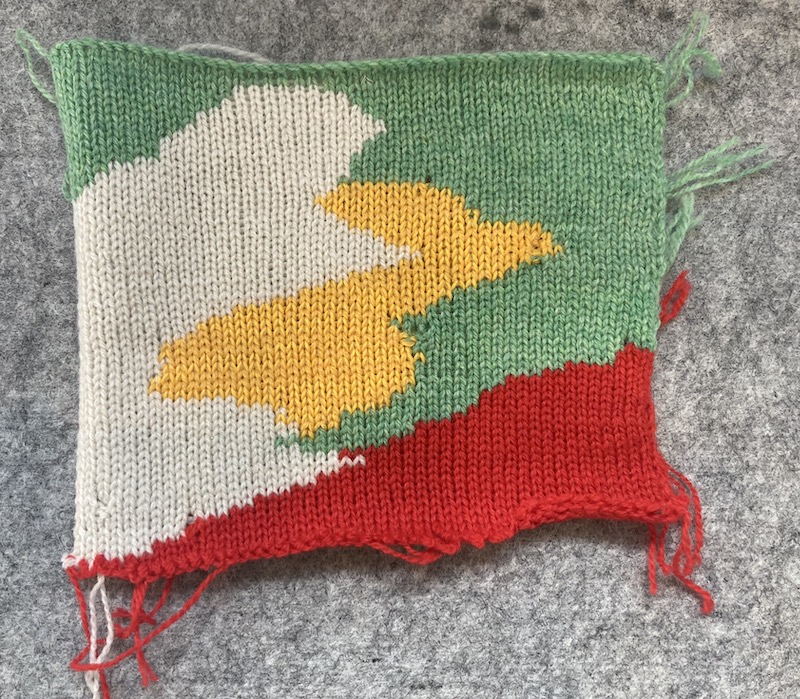
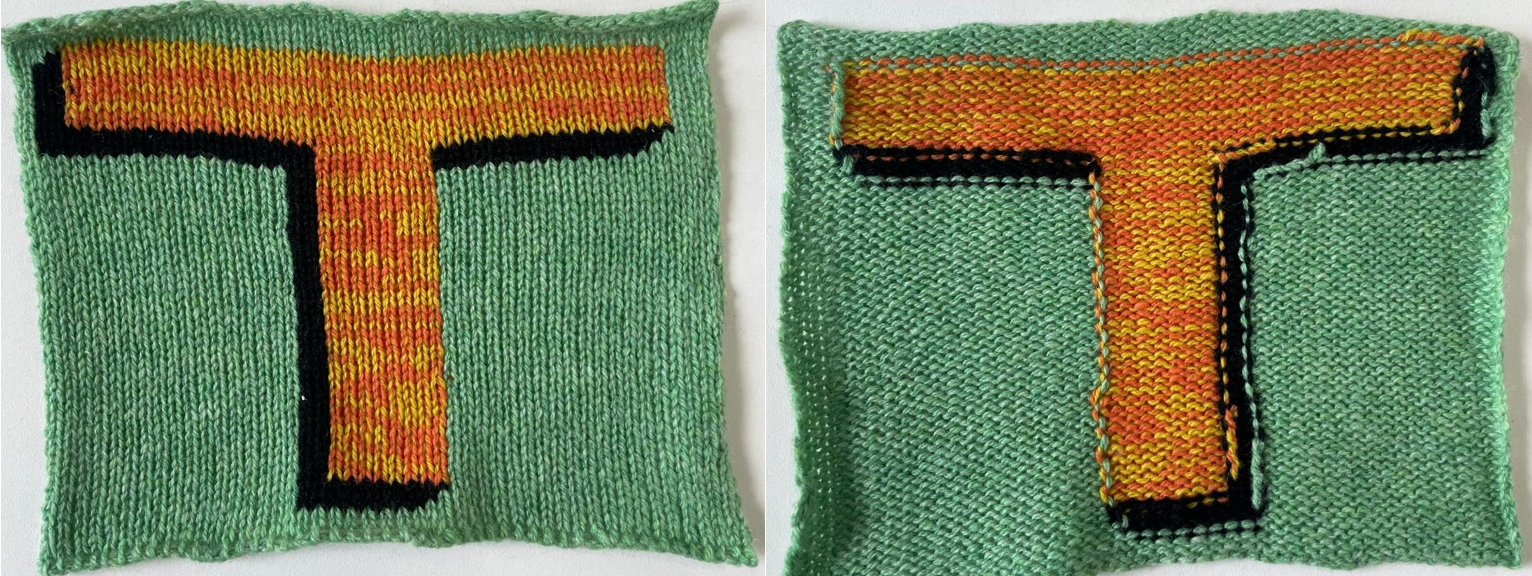
The Intarsia Carriage is an alternate carriage for the machine that allows multiple colours to be used in a single row, without having floats along the back like in Fair Isle. It produces large blocks of colour (if you want to use fine detail, Fair Isle is normally a better bet), though requires considerably more manual effort than the digital fair isle. Below is an image of the intarsia carriage, and a sample of knit made using it.
Automatic Colour Changer
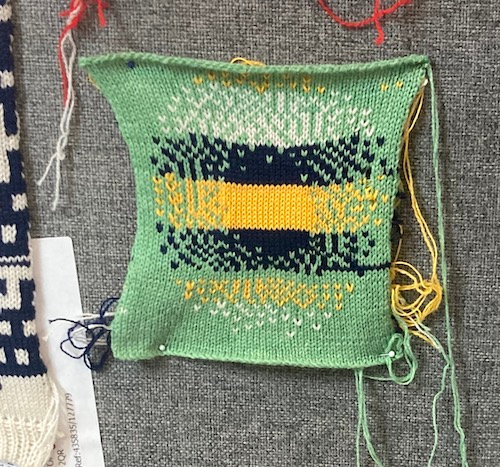
We have an automatic colour changer in the CCI, that makes changing colour between rows considerably faster, and also allows selection between 4 yarns, rather than 2. It cannot change colours within a row (for that, you want either fair isle or intarisa) -- instead think of it as a way of making stripes a lot more efficient. It's particularly useful when knitting tuck mosaic patterns that require regular colour change. The automatic colour changer may also be used with fair-isle or other patterning techniques (see example below), though when using 2 yarns (as in Fair Isle) only one may be changed automatically.
Please talk to Agnes before using the automatic colour changer for the first time.

E-textiles and technical knits
The knitting machine can also be used to create textiles with electronic properties, including conductive and stretch sensors, and even radio components. Please see this guide to knitting with conductive yarn for more information.
Resources
- learnmachineknitting.com
- alessandrina.com -- really useful knitting documentation site
Choosing Yarns
We provide a range of yarns at the CCI that are compatible for use with the machine. It is strongly suggested that when starting to use the machine, you make use of the 2-ply lambswool we provide (and that will be used during tutorials). 2 strands of the lambswool are threaded through the tensioner together to create a 4-ply yarn.
If you are planning to create larger projects (e.g. bigger than a standard sample swatch), we ask that you source your own yarns. Finding yarns suitable for machine knitting is a different task than for hand knit: this guide offers a good overview of considerations. In general, you will have more luck with yarns intended for machine knitting -- talk to Agnes if you would like more advice.
At the CCI, our main yarn supplier is Uppingham Yarns, who have a wide range and high quality. Other recommended suppliers include:
- Knit Works in Bethnal Green -- this place is worth a visit, they also have machine knitting classes + sell a very wide range of machine yarns.
- Denier Studio in Tottenham -- they sell deadstock yarns, good on both a sustainability front and tend to be a lot cheaper.
Machine Knit Inspiration
electronic textiles
machine knitting for actuation/active textiles
textbooks
- A Complete Guide To Machine Knitting (ask Agnes to borrow her copy)