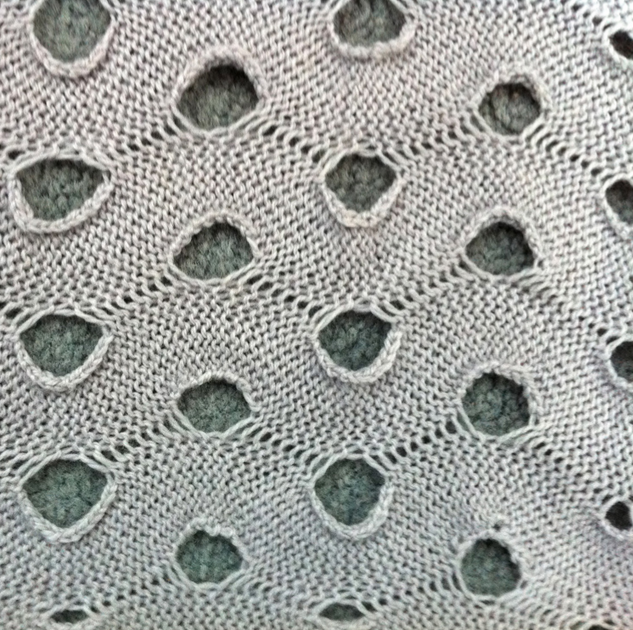
Short Rowing (Partial Knitting)
Short rowing is a method that allows you to put needles 'on hold' and knit a row without adding a new stitch onto every needle (called a short or partial row). This allows you to create interesting shapes including non-flat and curved swatches (such as the heel or toe of a sock). It also allows you to knit swatches that have a concave shape, such as a star or the neckline of a jumper.
The terminology for this can be a little confusing so lets make some definitions:
- Working needle - a needle that is currently being knit with (so is in either B or C position)
- Working section - the section of needles that is currently in work
- Hold - the state of not being in work (i.e. in D position)
- Decreasing - reducing the number of working needles therefore means bringing more needles into D position
- Increasing - increasing the number of working needles therefore means bringing more needles back into B/C position
Decreasing
To decrease the number of working needles, we will put some on hold by pushing them out into D position. This must be done on the opposite side of the working section to the carriage.
There are 3 steps to this process:
- Push needles to be decreasing into D position (on the opposite side of the carriage)
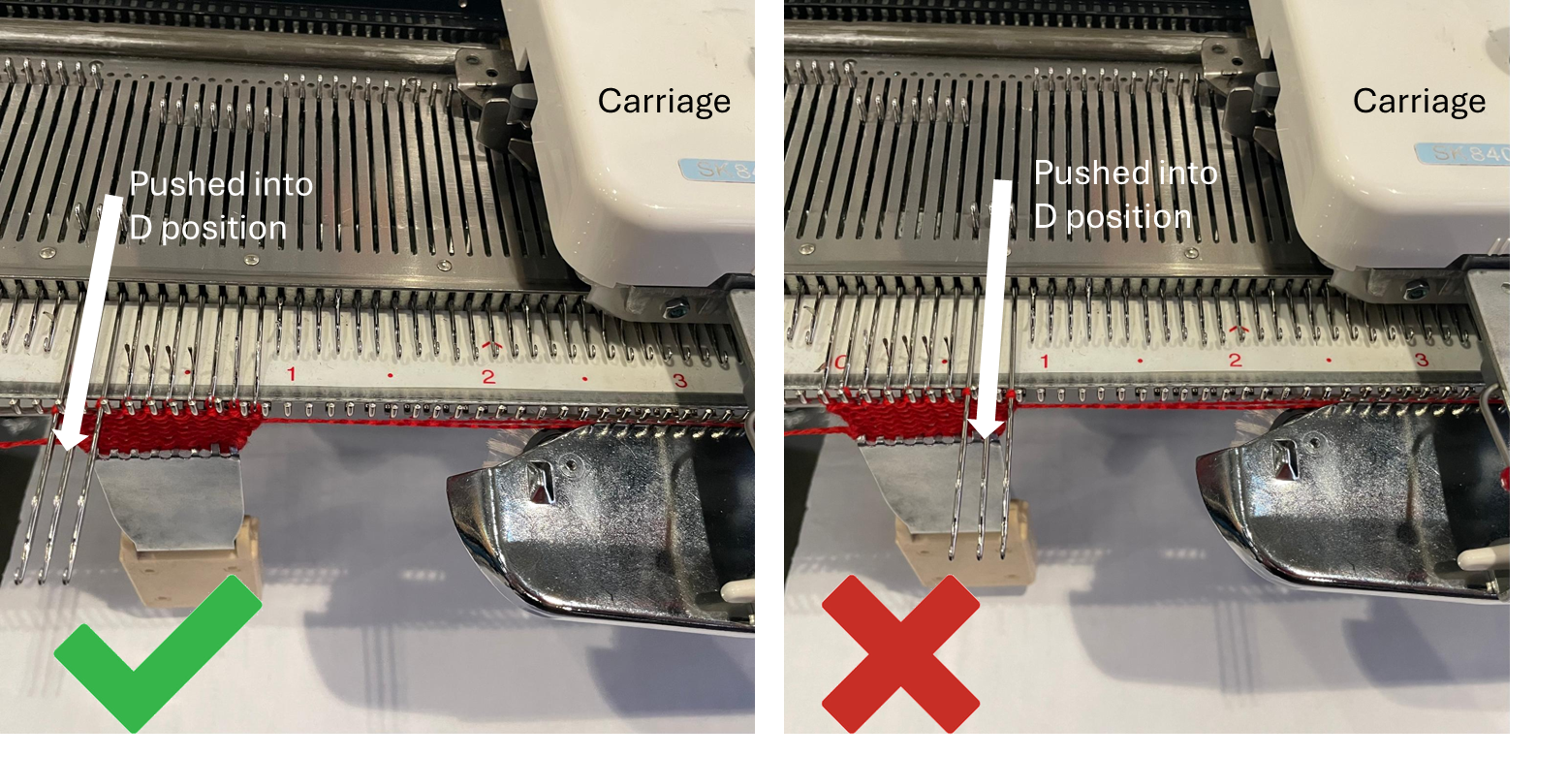
- Knit 1 row
- Loop the yarn under the first inside needle in D position and over the remaining needles
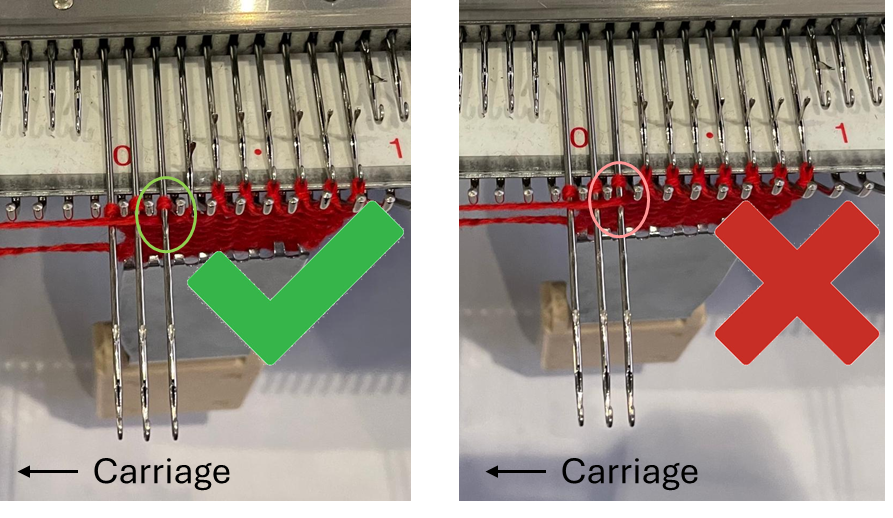
If you want to decrease on alternating sides each row, the first and third steps of the left- and right- hand side processes will overlap. See the table below.
| Right-hand side | ||
|---|---|---|
| Row 1 | 1 | |
| Row 2 | ||
| 3 | 1 | |
| 1 | 3 | |
| 1 | ||
| ... | ... | ... |
Increasing
To increase the number of working needles, we need to bring them back into B position. The process for this changes slightly depending on the knitting method that you are using.
If knitting in:
- Stockinet - Push the needles to be increasing into C position.
- Pattern Knitting (e.g. fairisle) - Using a transfer tool, return the needles to be increase back into B position.
This increase can only be done on the opposite side of the working section to the carriage.
Examples
Here is a tutorial on how to knit the below swatch using short rowing. It is a good one to follow to help yourself fully understand how short rowing works.