
Machine Knitting Overview
Please be aware that the knitting machine will be in use for inductions on Thursdays and Fridays 10:00-13:00
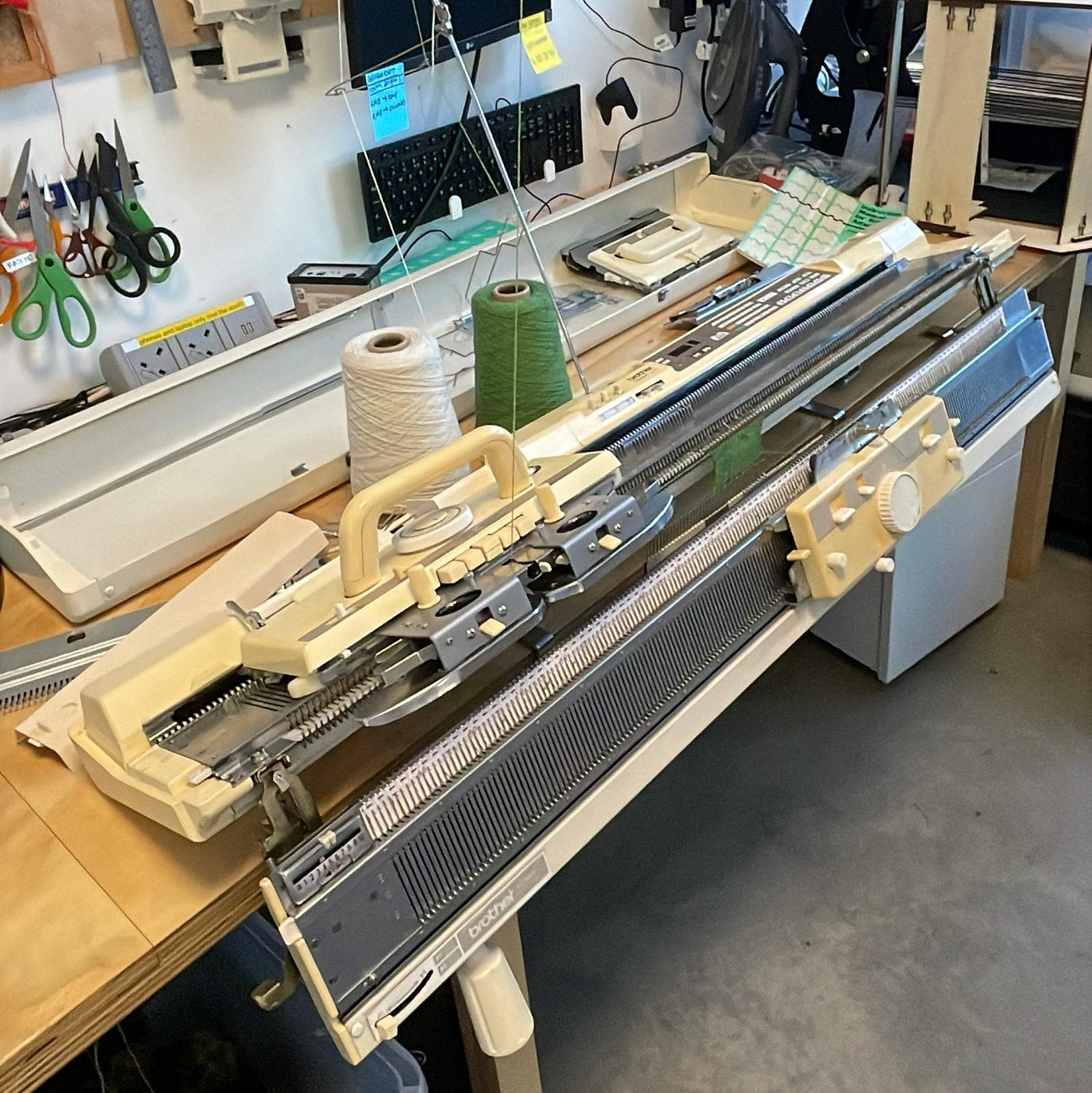
The Brother KH-940 knitting machine is a 4.5mm standard-gauge flat-bed machine. The manual is available online here, and we have a paper copy in the lab. You must have completed the Knitting Machine Induction before using the machine.
Stitches and Techniques
In machine knitting, knitted fabric is created by manually sliding the carriage back and forth over the needle bed. Each stitch is formed as the needle pulls a new loop of yarn through the stitch on the previous row. Knitting is distinct from weaving: in weaving, fabric is created by interlacing 2 sets of threads at right angles to one another, while knitting involves taking a single thread and looping it around itself, one row at a time. (we currently don't have any weaving capabilities in the CCI).
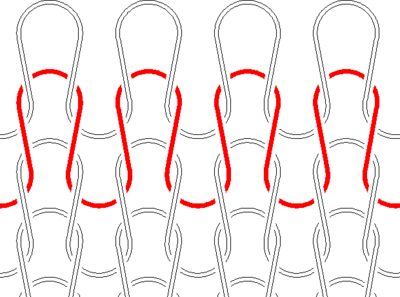
The two foundation stitches in knitting are the knit and purl stitches. These are the reverse of each other, meaning that you are pulling the yarn through the previous stitch from the opposite direction.
After completing the Knitting Machine Induction, there are four Advanced Workshops that cover a variety of techniques:
- Short Rowing
- Tuck and slip stitches and the automatic colour changer
- Intarsia
- Fair Isle and DesignaKnit
After you have practiced enough on the single bed, you can then complete the Ribber Induction to learn how to use the second bed.
E-textiles and technical knits
The knitting machine can also be used to create textiles with electronic properties, including conductive and stretch sensors, and even radio components. Please see this guide to knitting with conductive yarn for more information.
Resources
- learnmachineknitting.com
- alessandrina.com -- really useful knitting documentation site
Choosing Yarns
We provide a range of yarns at the CCI that are compatible for use with the machine. It is strongly suggested that when starting to use the machine, you make use of the 2-ply lambswool we provide (and that will be used during tutorials). 2 strands of the lambswool are threaded through the tensioner together to create a 4-ply yarn.
If you are planning to create larger projects (e.g. bigger than a standard sample swatch), we ask that you source your own yarns. Finding yarns suitable for machine knitting is a different task than for hand knit: this guide offers a good overview of considerations. In general, you will have more luck with yarns intended for machine knitting -- talk to Agnes if you would like more advice.
At the CCI, our main yarn supplier is Uppingham Yarns, who have a wide range and high quality. Other recommended suppliers include:
- Knit Works in Bethnal Green -- this place is worth a visit, they also have machine knitting classes + sell a very wide range of machine yarns.
- Denier Studio in Tottenham -- they sell deadstock yarns, good on both a sustainability front and tend to be a lot cheaper.
Machine Knit Inspiration
electronic textiles
machine knitting for actuation/active textiles
textbooks
- A Complete Guide To Machine Knitting (ask Agnes to borrow her copy)