
Machine Knitting Overview
Please be aware that the knitting machine will be in use for inductions on Thursdays and Fridays 10:00-13:00
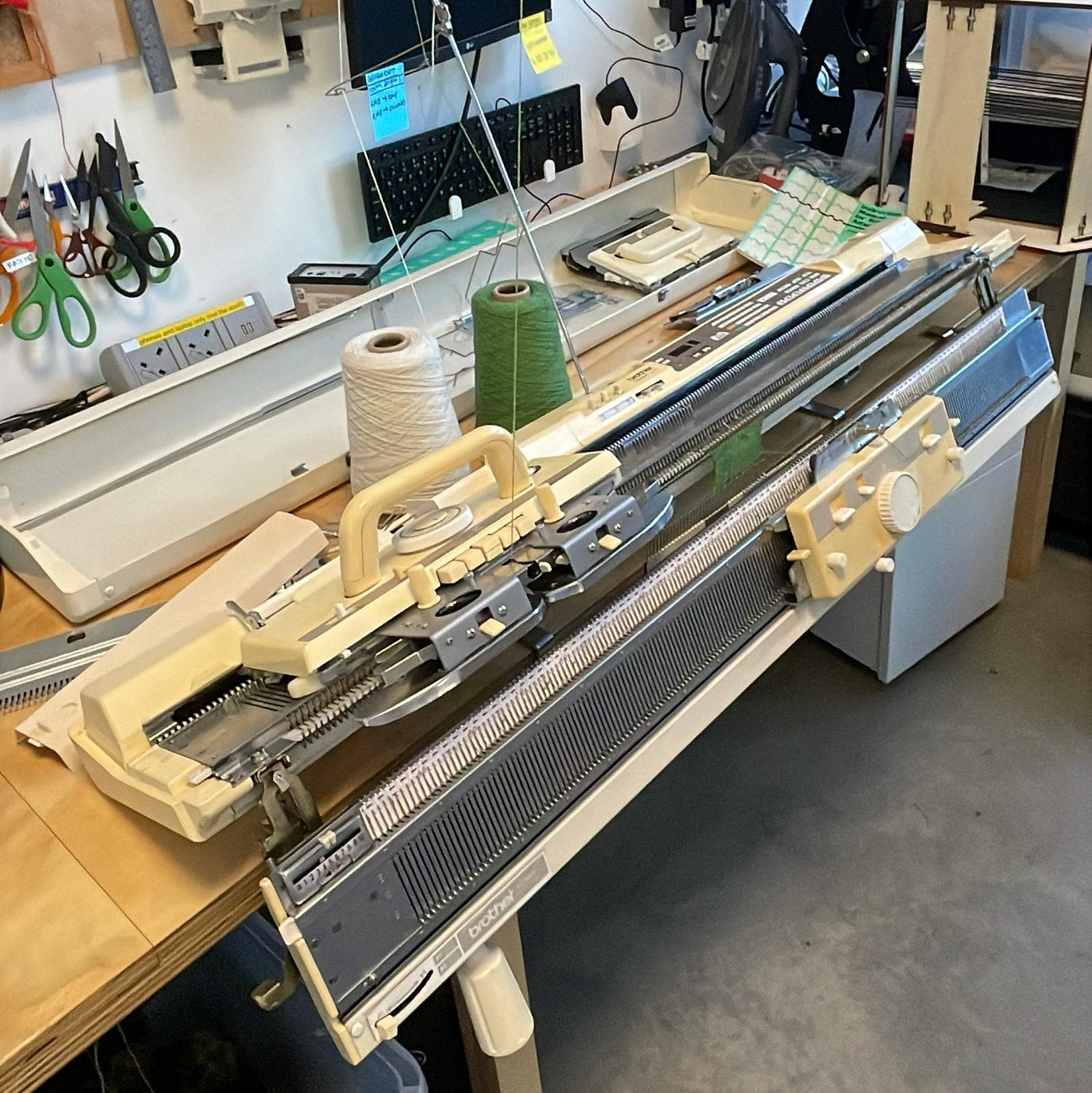
The Brother KH-940 knitting machine is a 4.5mm standard-gauge flat-bed machine. The manual is available online here, and we have a paper copy in the lab. You must have completed the Knitting Machine Induction before using the machine.
Inductions and Workshops
Knitting Machine Induction
Inductions for the Knitting machine are bookable on ORB here. This induction lasts 3 hours and will teach you the basics of single bed machine knitting. You will learn how to:
- Thread the auto-tension
- Cast-on using two different techniques (e-wrap and weaving)
- Increase and decrease stitches using two different techniques (fully fashioned and cast-on/cast-off)
- Change colour
- Change stitch sizes
- Cast-off with the transfer tool
- Debug and fix mistakes
Advanced Knitting Workshops
After you have completed the Knitting Machine Induction, you will be able to attend any of the four Advanced Workshops. They are all bookable on ORB here.
Short Rowing
Short rowing is a method that allows you to put needles 'on hold' and knit a row without adding a new stitch onto every needle (called a short or partial row). This allows you to create interesting shapes including 3d and curved swatches (such as the heel or toe of a sock).
DesignaKnit and Fair Isle
DesignaKnit is a pattern drafting, garment design, and interactive machine control software for knitting machines. It can be used for a number of things including creating colour work with a technique called Fair Isle.
In this workshop you will learn how to:
- Create shape files
- Create stitch files
- Convert images to stitch files
- Upload files onto the Knitting machine
- Knit Fair Isle patterns
Intarsia
Intarsia is a colour work technique that allows the creation of patterns with more than 2 colours per row and no floats. It is especially useful for working with conductive yarns and the lack of floats means that you can create sections that are conductively isolated from each other.
E-textiles and technical knits
The knitting machine can also be used to create textiles with electronic properties, including conductive and stretch sensors, and even radio components. Please see this guide to knitting with conductive yarn for more information.
Resources
- learnmachineknitting.com
- alessandrina.com -- really useful knitting documentation site
Choosing Yarns
We provide a range of yarns at the CCI that are compatible for use with the machine. It is strongly suggested that when starting to use the machine, you make use of the 2-ply lambswool we provide (and that will be used during tutorials). 2 strands of the lambswool are threaded through the tensioner together to create a 4-ply yarn.
If you are planning to create larger projects (e.g. bigger than a standard sample swatch), we ask that you source your own yarns. Finding yarns suitable for machine knitting is a different task than for hand knit: this guide offers a good overview of considerations. In general, you will have more luck with yarns intended for machine knitting -- talk to Agnes if you would like more advice.
At the CCI, our main yarn supplier is Uppingham Yarns, who have a wide range and high quality. Other recommended suppliers include:
- Knit Works in Bethnal Green -- this place is worth a visit, they also have machine knitting classes + sell a very wide range of machine yarns.
- Denier Studio in Tottenham -- they sell deadstock yarns, good on both a sustainability front and tend to be a lot cheaper.
Machine Knit Inspiration
electronic textiles
machine knitting for actuation/active textiles
textbooks
- A Complete Guide To Machine Knitting (ask Agnes to borrow her copy)